


Amnesty Australia created a challenge for its website to attract more diverse youth audiences as part of a 3-Week Monash Innovation Guarantee (MIG) program I attended.
Project Background
In Australia, Amnesty’s vision is to shine the lights on local and international human rights abuses and challenge injustice.
As a team of 6, we performed user research and competitive analysis, created user flow, wireframes and prototypes in a 3-week sprint to innovate a solution to their challenge.
Understanding the Challenge
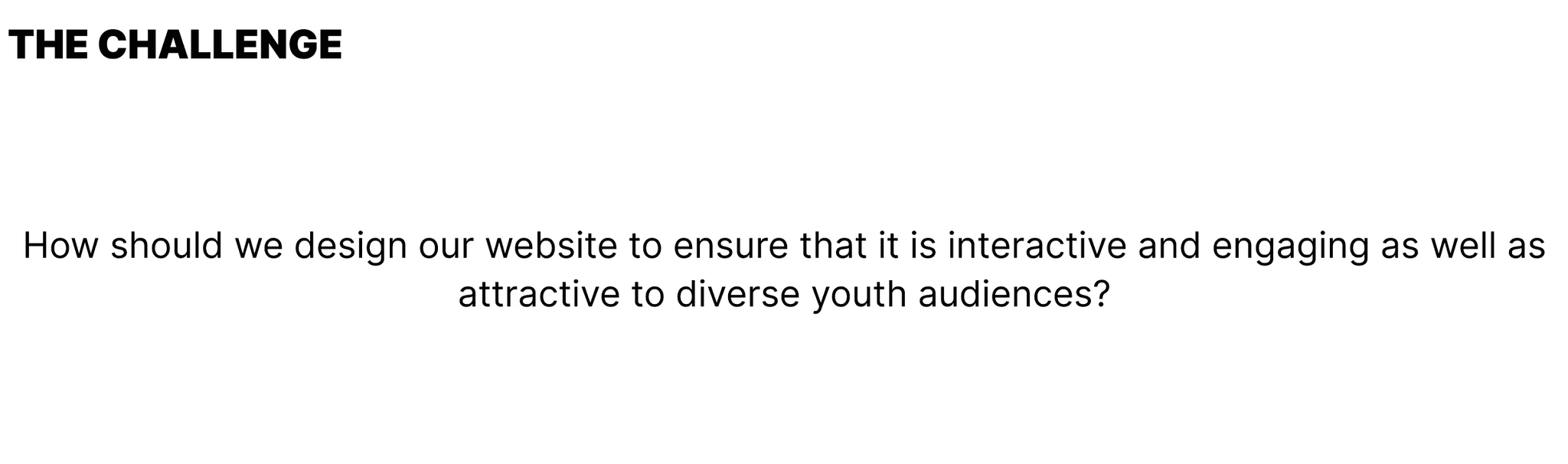
“What should we design in our website to ensure it is interactive and engaging as well as attractive to diverse audiences?"
Design a framework/concept for Amnesty's website that is interactive and engaging, able to attract diverse audiences and provide curated opportunities for children and young people to contribute to our movement in a way which suits their capacity.
The Goal
Through the website, improving the brand image of Amnesty and increasing brand awareness amongst young people.
The Focus
Delivering concise information that motivates and encourages Australia's young people to be continuously and permanently involved.
Design process
We used a 5-stage Design Thinking model explained during the Human-centred design Master class at the MIG program led by Dr Ilya Fridman. The stages of this Design Thinking process are as follows:
1. Empathise, 2. Define, 3. Ideate, 4. Prototype, 5. Test.
Empathise - Our challenge map

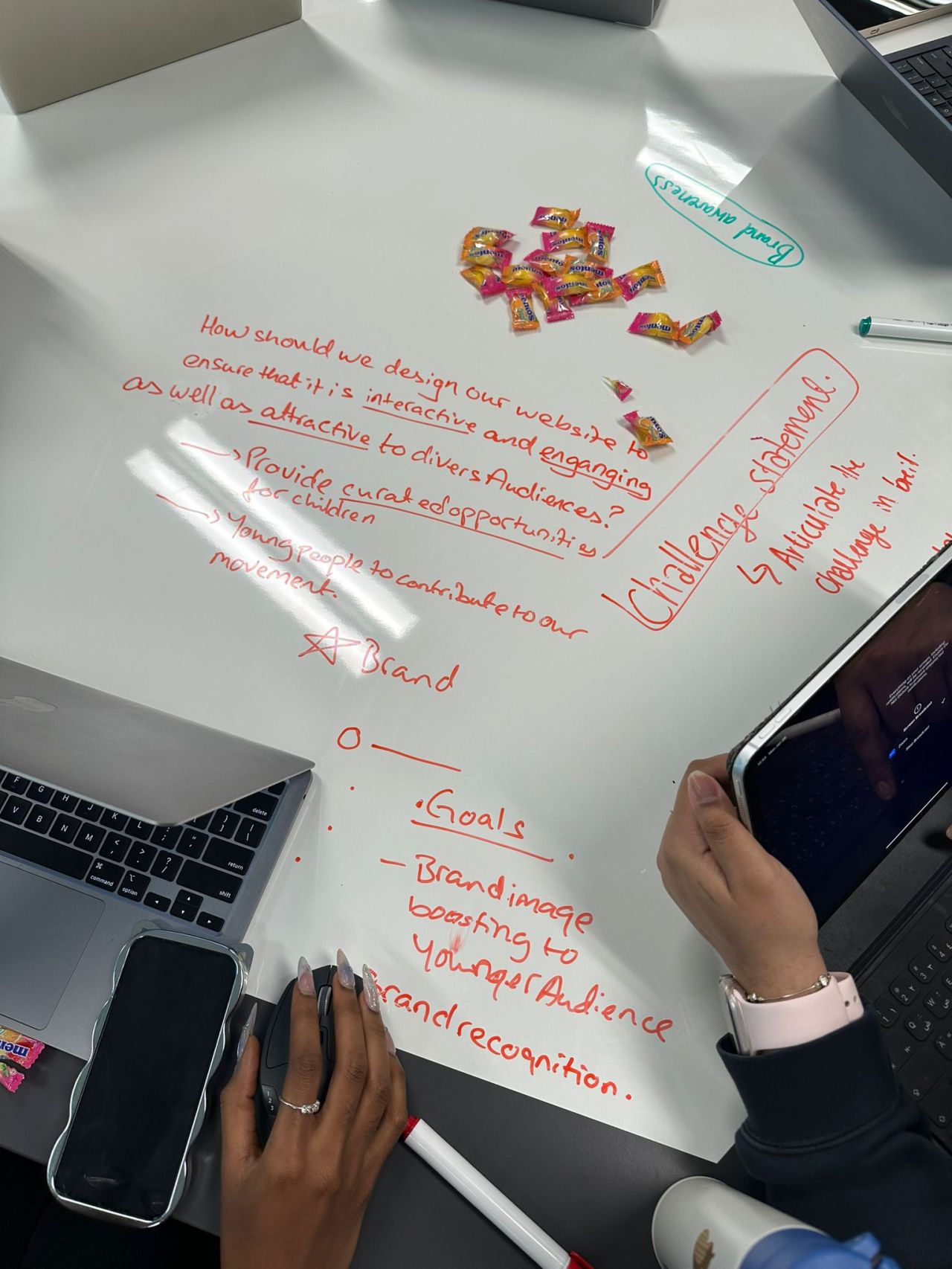
The graph above largely speaks for itself. After conducting our requirements gathering in the first week, we drafted out Our challenge map; it helped us understand why youth engage less with the current Amnesty website. Our conclusion was that, our solution would have to addresses the interactivity of the website and brand awareness to create a more engaging Amnesty website for youth.
Define - Our challege targets
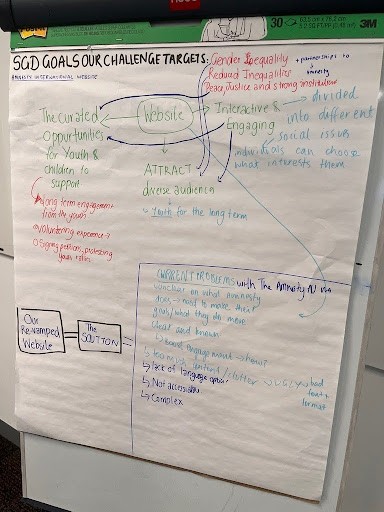
The first week of the 3-week sprint was focused on defining the problem and targets. We agreed as a team that there were three major targets, highlighted in the image above that any solution we came up with must meet.
- An interactive and engaging solution
- able to attract a diverse audience
- can highlight curated opportunities
It was a simple rule to make sure our ideas were not too far-fetched for the challenge.
Ideate - Our Top 2 Solutions
Personas - Faces of Advocacy
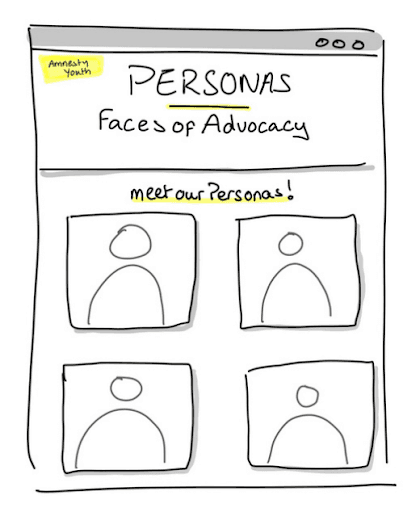
Bring social issues to life by spotlighting the diverse personas behind the causes.
Action Arcade
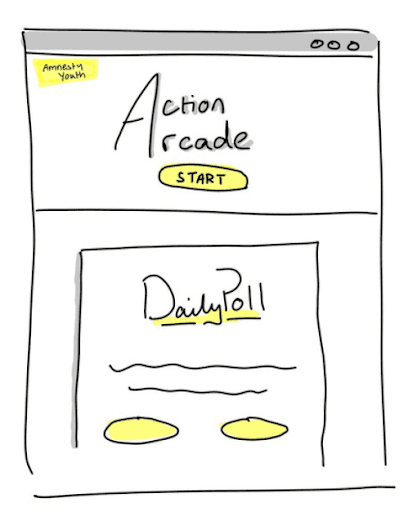
Transforming human rights education into an engaging and empowering gaming experience.
Decision making
Between week 1 and 2, we ideated possible solutions and made rough sketches of over 10 different solutions! Deciding on these as our final sketches took a lot of effort.
This was also because, as a team, we believed that the combination of the solutions would be the ultimate solution for the website but we were also aware that it was largely impracticable to implement both.
In the end we settled on our first solution: Personas, Faces of Advocacy. Because it satisfied the 3 targets we had proposed.
Prototype - Personas, Faces of Advocacy

Above is the low fidelity initial prototype we designed in week 2 along with the criterion for each persona as a way to tackle each of the targets we had.
Our rough sketches didn't take took long to create because we quickly incorporated our brainstorming ideas into rough sketches, and outlined the major Personas. They satisfied our targets and met the needs we had set.
User Research
Our first reaction to the solution came from our coach, Ruth in week 2. She was very excited about how quickly we had innovated the solutions and gave us a few pointers to brush up the solution and make it more presentable to our industry partners.
Then we had a meeting with our industry partners, Amnesty later that same week to pitch our idea. We got a lot of insight and emphasis on the use of personas for relatability and inclusivity.
This started our user research into the potential users of this solution.
Prototype - Storyboarding
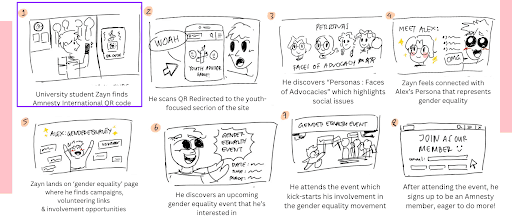
Based on the feedback that we got from Amnesty and the research we made into their users, we used Canva to design a suitable, non-biased and very practicable storyboard that reflected youth interaction with our solution.
As a user navigates through the website, they could interact with a persona. The Persona acts as a guide for the user to access opportunities offered by amnesty.
Final Prototype

Due to the timeframe of our project, we had to settle with this mid-level fidelity mock-up as our solution. User research and prototyping all occurred within the last week of the 3-week-frame. This included feedbacks from our tutor and industry partners at Amnesty.
The team at Amnesty had already pointed out that they did not want any changes to the current layout or design of their website. The solutions would merely be an addition to their platform
So our focus was in delivering the solution in line with the suggestions that our industry partners had highlighted but also keeping the original layout of their system so that it is intuitive and encouraging for new and returning users
Our solution
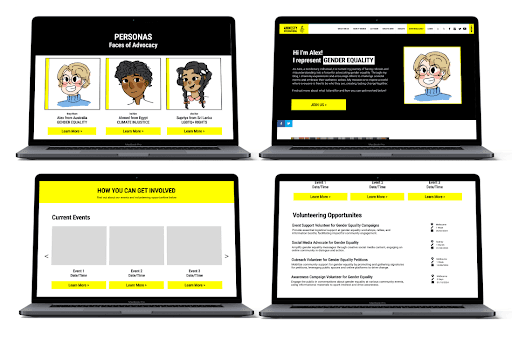
The dynamic interactive user platform made on Figma with personalised illustrations called Personas that would appeal to Amnesty Youth members.
Our Integration
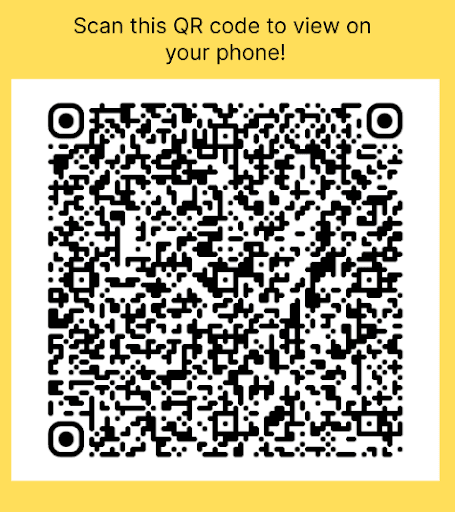
Taking our industry partners suggestions into context we also brainstormed a seperate solution for ease of access to the personas. The QR code that will directly lead you to the youth website of Amnesty.
Post Prototyping Process + Testing
In a discussion with our industry partners at Amnesty International about the importance of representing youth, as a final change while testing, we developed a QR code for increased accessibility to the youth section and emphasised using personas for relatability.
After interviewing 6 youth members and considering Amnesty International's feedback, we found that the users prioritised credible content for reliability.
Our prototype emphasised visuals, concise info, and captivating titles for better engagement. Users also noted that long-term engagement could be achieved through event promotions, loyalty programs, personalised experiences, and regular newsletters.
While vibrant colours are effective, we were able to improve the accessibility of the youth section to address the challenge. These insights ensure our solution would attract and engage a diverse youth demographic.